
You check the account on a Thursday evening. It says $4,200. That feels like a lot. You book the restaurant.
But $1,900 of that is rent, due in eleven days. Another $1,100 is childcare. Some of it is next week's groceries. The $4,200 was true, it just wasn't yours.
Your balance answers "how much money is in here?" The question you actually have is "how much of this can I spend without breaking anything?" That's a different number, and most people never calculate it. They estimate it by feel, which works right up until it doesn't.
The definition
Here's a definition worth adopting:
Free to spend = this paycheck − the bills it has to cover before the next payday − its share of everyday spending.
Three parts, each doing a specific job.
This paycheck. Not the balance. The balance mixes this paycheck with leftovers, money set aside for something else, and whatever the last paycheck was supposed to be holding for rent. Start from what came in.
The bills it has to cover. Every bill due from today up to the day before your next payday. Not the whole month's bills, and not none of them. Just this window.
Its share of everyday spending. Groceries, gas, school lunches, the pharmacy. These aren't bills, but they aren't optional either. If you plan $1,400 a month for them and you're paid twice, each paycheck owes about $700.
What's left really is free. You can spend it on dinner out, put it toward a debt, or leave it alone, and nothing in the plan gets hurt.
A worked example
A made-up household, paid $3,000 every other Friday. Today is the 17th, payday. The next payday is the 31st.
| Amount | |
|---|---|
| This paycheck | $3,000 |
| Internet (18th) | −$80 |
| Credit card payment (21st) | −$300 |
| Childcare (26th) | −$1,100 |
| Streaming (28th) | −$45 |
| Share of everyday spending | −$700 |
| Automatic transfer to savings | −$150 |
| Free to spend until the 31st | $625 |
Notice what isn't there: rent. It's due on the 1st, and the paycheck on the 31st will be in the account by then, so it's that paycheck's job. Next month the Fridays shift and the rent may land on this paycheck instead. That's why the number gets worked out fresh every payday rather than once a year.
So: $625 for fourteen days, a little under $45 a day. Compare that with the $4,200 balance that started this. Same household, same evening, a very different decision about the restaurant.
What it isn't
It isn't the grocery money. Groceries are already taken out. If you're running low on groceries, that's a separate problem with a separate fix: check what's left in that pocket and how many days it has to last.
It isn't savings. If you move money to savings every payday, treat that transfer like a bill so it comes off before you see the number. Money you only save "if there's some left" mostly isn't saved.
It isn't a target. A free-to-spend figure of $625 doesn't mean you should spend $625. It means you can without consequences. Some paychecks you'll want to spend less of it and send the rest somewhere useful.
When the number is small, or negative
A negative free-to-spend number is good news, oddly. It's telling you something true while there's still time to act.
Usually it means one of these:
- This paycheck carries a big bill. Rent, the mortgage, a quarterly insurance premium. Look at the paycheck before it: does it have room to set some aside? Moving a fixed amount from the long paycheck to the short one every time is the cleanest fix.
- An irregular cost landed in the window. Car registration, a school fee. Next time, that's a sinking fund, saved a little each month, so it doesn't land on one paycheck.
- The plan has stale estimates. If the electric bill is really $180 and the plan says $120, the number is optimistic every month. Replace the estimate with what actually came out.
- The plan is bigger than the income. If every paycheck is negative, it isn't a timing problem. Something has to come out of the plan.
Keep it honest during the fortnight
A free-to-spend figure is worked out on payday, but life keeps happening. Two habits keep it useful:
- Tick bills as they go out. If a bill came in higher than planned, record the real amount. The next calculation will be right.
- Check the spending pockets mid-way. If groceries are running ahead, you'll know before the free money gets spent covering them.
Step by step
Do it in Payday Plan
Payday Plan works this number out for you on The Plan, from the same plan as the Month page, so the two always agree. It needs to know when your paychecks land, so add those first if you haven't.
Add your paychecks. On The Plan, type something like "I get paid $3,000 every other Friday, next one Nov 6" into the bar at the top and tap Go, then Read it, then Make this change.
Find the number. On The Plan, scroll past the card with the month's total. The next card reads Free to spend until the next payday, with the amount underneath and a line saying which paycheck it's from. If the paycheck can't cover its bills, the card says Short in red instead, and suggests moving money in or pushing a bill to the next paycheck.
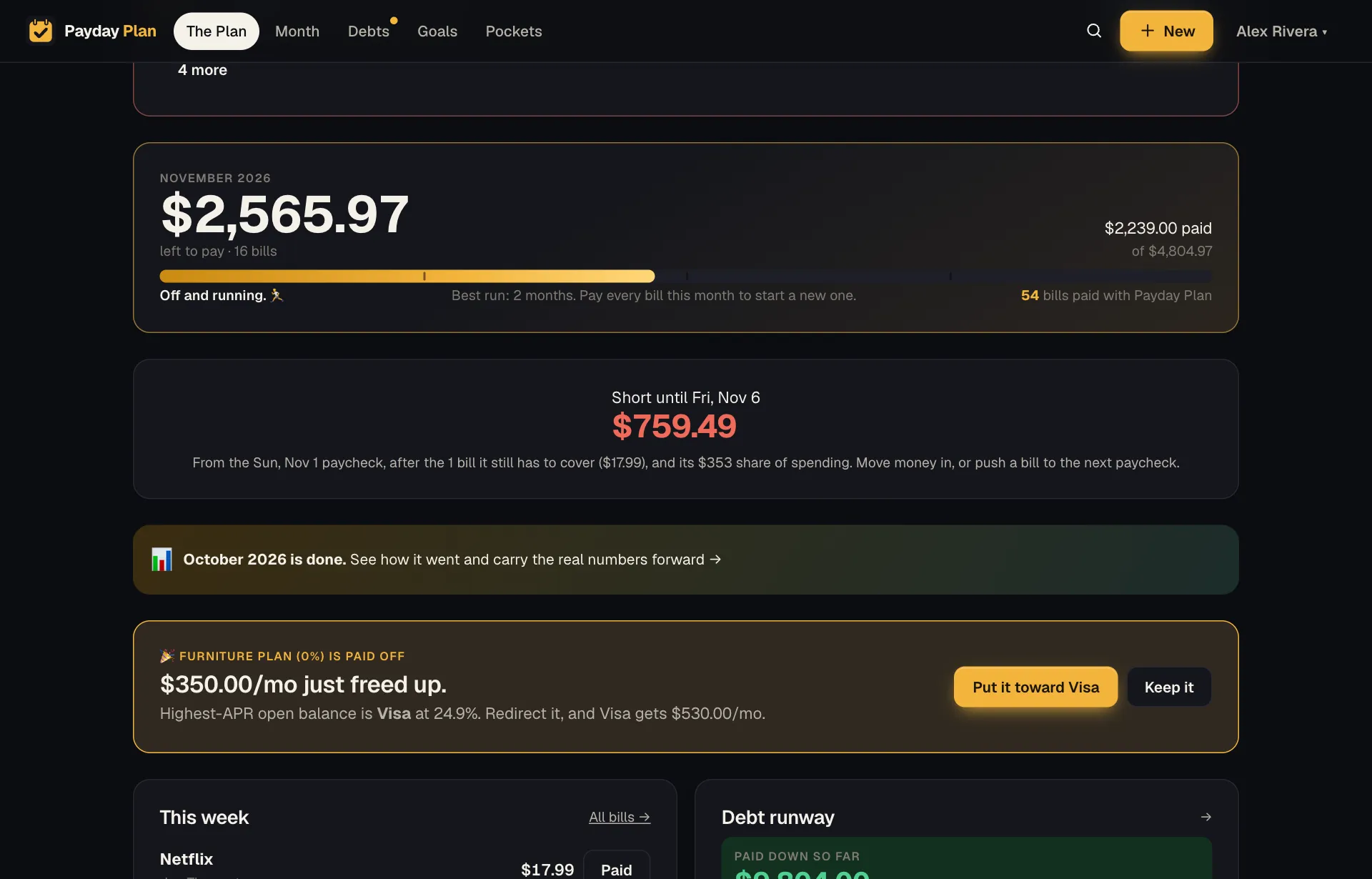
When a paycheck can’t cover its bills and its share of spending, the card says Short instead, with the amount and what to do about it. See what's behind it. Tap the card. It opens Month → By paycheck, where the paycheck you're on lists every bill it covers, the total going out and what's left.
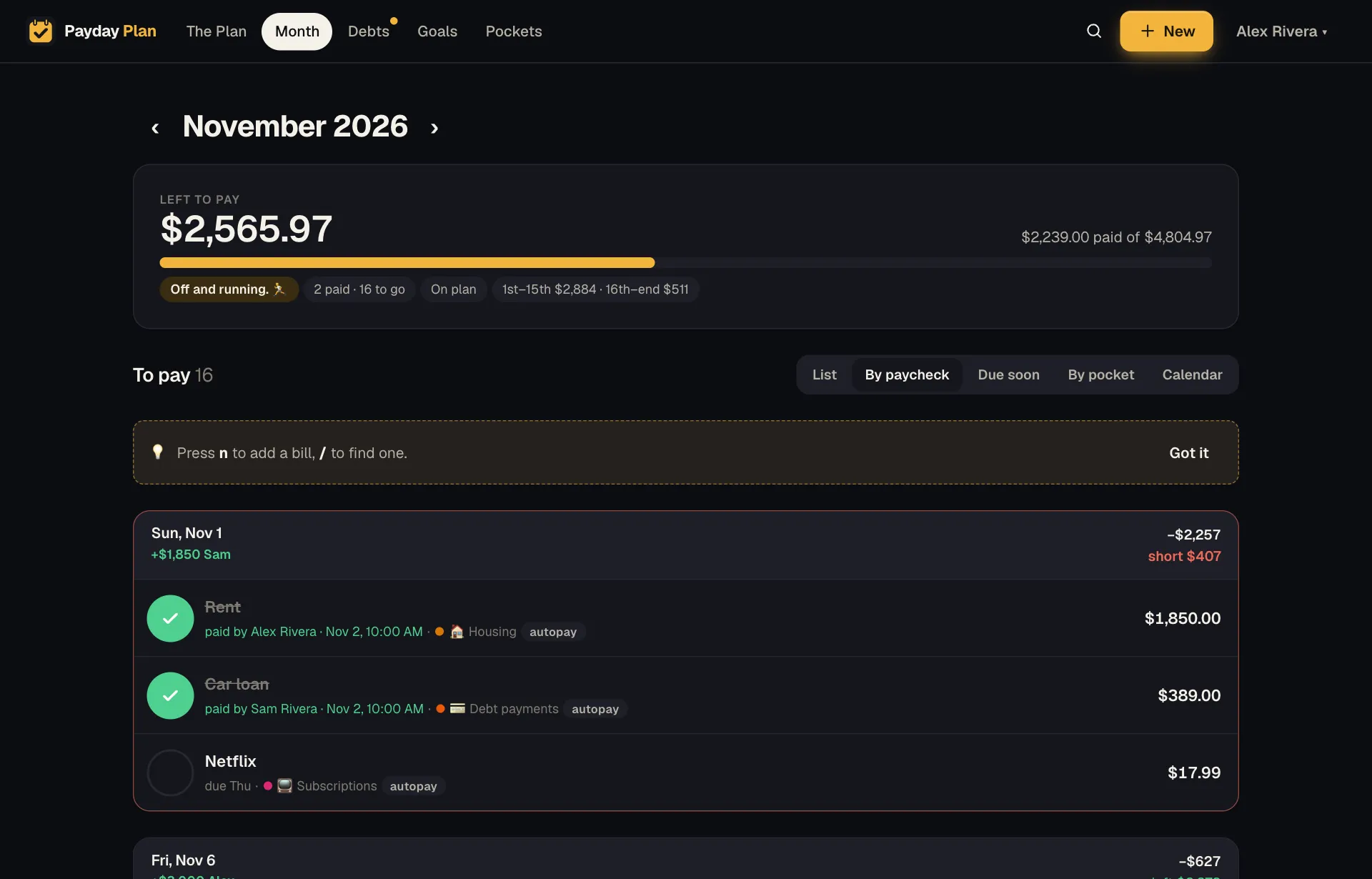
Tapping Free to spend opens this view. Each paycheck shows the bills it covers and what’s left, or how short it is. Record a bill that came in different. Type it into the bar on The Plan, tap Go, then Read it. You'll get a This month's amount card; tap Make this change. Or do it on Month: tap the bill's name and type the real figure in Actually came out (Will actually be, if it isn't paid yet).
The electric bill came in at $212
That records this month's amount without rewriting the plan, and Free to spend moves with it.
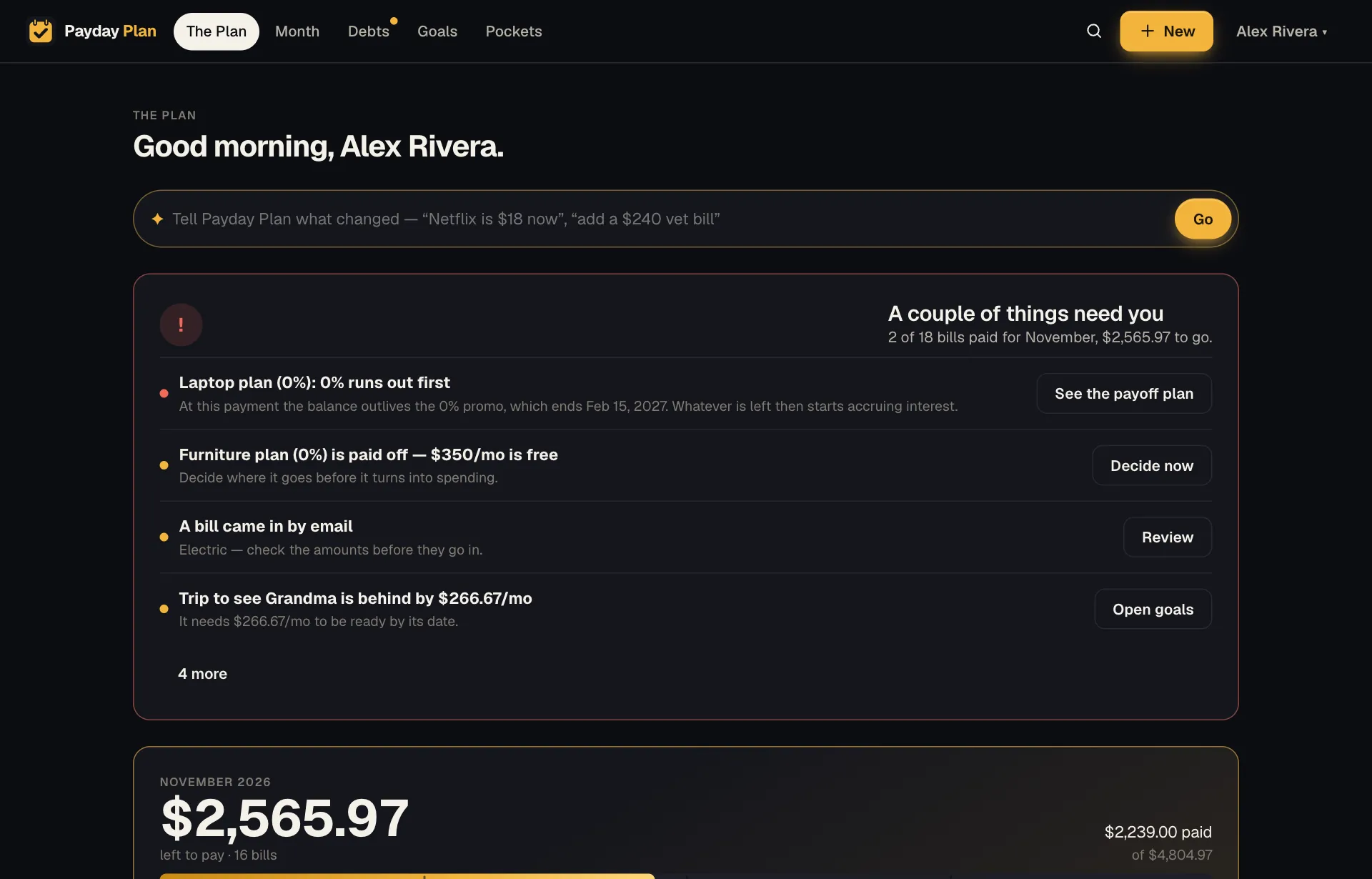
The bar at the top of The Plan takes a sentence about anything that changed. Nothing is saved until you’ve seen what it understood. Check the spending pockets mid-way. On The Plan, find the Spending pockets card and tap Check in. Type what your bank says each spending pocket has left, then tap Check in at the bottom of the sheet. The card then shows an amount a day for the days left in the month.
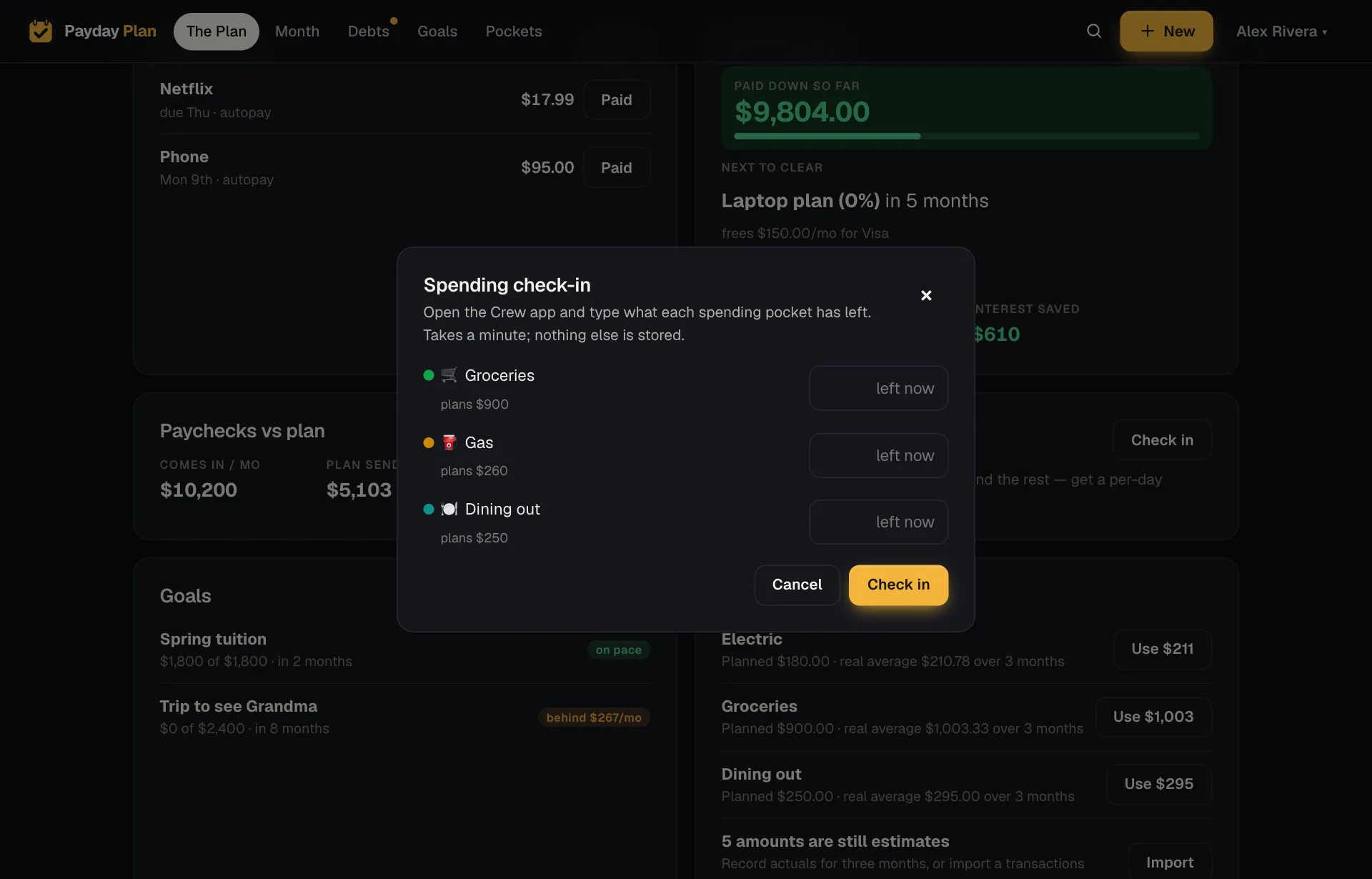
Type what your bank says is left in each spending pocket; Payday Plan works out a per-day amount for the rest of the month.
Why one number helps
Budgets fail less from bad maths than from friction. If knowing whether you can afford something means opening a spreadsheet, you won't, and you'll guess. A single number you can glance at in the checkout line gets checked. A good one is also a conversation-saver between two people: it's hard to argue about "can we afford it?" when the answer is written down and you both agreed how it's worked out.
This guide is general information about planning a household budget, not personal financial advice. Your numbers, rates and situation are your own — check the terms of your accounts before you act.
Keep reading
More guides
Plan the month by paycheck, not by calendar
Your bills run on the calendar but your money arrives on paydays. Line them up by paycheck and the tight weeks stop being a surprise.
PaychecksThe extra paychecks: what to do with a three-paycheck month
Paid every other week? Twice a year, a month brings a third paycheck. Here's how to spot those months now and give that money a job.
BillsForward the bill, skip the typing: emailed bills, set up properly
Most bills already arrive by email. Forward them to bills@paydayplan.app, or set a filter once, and this month's amounts wait for a yes.
Your next payday could come with a plan.
Payday Plan is opening to households a few at a time. Ask for a spot, or sign in if you’re already in.